How Full Is Your Sink?
No, I’m not asking whether you’ve done the washing up! I’m talking about a different kind of sink. One that we all have, although we can’t actually see it. A sink that helps explain emotional overwhelm and why sometimes even the smallest thing can feel like too much.
I’m talking about a different kind of sink. One that we all have, although we can’t actually see it.
Recently, during a conversation with Leo’s behaviourist, we were talking about emotional overwhelm and how different situations can affect his ability to cope.
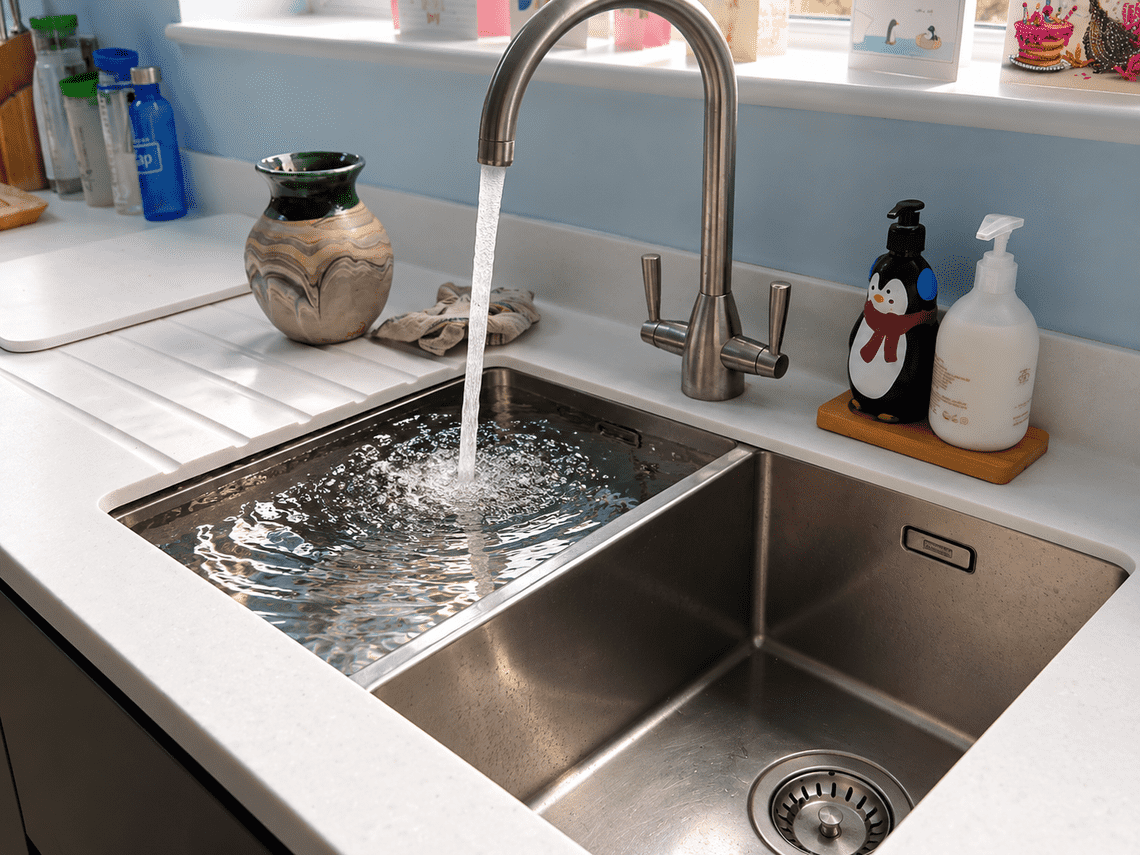
She explained it using the analogy of a sink filling with water.
Different experiences and emotions turn on the taps, gradually filling the sink until there’s no room left.
And when the sink overflows, so do his emotions.
It got me thinking.
We’re not really that different, are we?
How full is your sink? And, perhaps more importantly, do you know how to empty it before it overflows?
What makes your sink fill up?
Imagine that everything you experience adds a little water to your sink.
Some days, there’s barely a trickle.
Other days, the taps seem to be running at full speed.
Work deadlines, family responsibilities, unexpected problems, financial worries, health issues or simply having too many things demanding your attention.
They can all add water to your sink.
And it’s not necessarily one big thing that causes a problem.
Sometimes it’s lots of little things.
An email that needs answering. A phone call that takes longer than expected. Something that doesn’t work the way it should. A change of plans when you’ve already organised your day.
Individually, none of them might be particularly difficult to deal with.
But together?
Drip, drip, drip.
Before you know it, the water is getting dangerously close to the top.
And then something else happens.
Something that, on a different day, you might have dealt with without giving it a second thought.
But today?
Your sink overflows.
How much water can your sink hold?
Here’s something else worth thinking about.
How much capacity has your sink actually got?
Because we’re not all working with the same-sized sink.
Some people seem to have enormous sinks. They can juggle multiple responsibilities, cope with unexpected changes and still have room for more.
Others have smaller sinks.
But there’s something else to consider.
Even your own sink doesn’t necessarily have the same amount of space available every day.
If you’ve slept badly, you’re feeling unwell, you’re in pain or you’ve already had an emotionally demanding week, there might already be water sitting in your sink before the day has even started.
Think about it in business.
You might comfortably manage five tasks on Monday but struggle with three on Thursday.
Does that mean you’ve suddenly become less productive?
Or does it mean that something else has already filled part of your sink?
Knowing how much capacity you’ve got available is far more useful than constantly trying to squeeze more in.
Which taps are running?
Now, imagine your sink has two taps. One hot and one cold.
Different emotions and experiences can turn on either tap.
Sometimes only one is running.
Sometimes they’re both running at once.
Perhaps you’re excited about a new opportunity but also worried about whether you’ve got enough time to deliver it.
Maybe you’re looking forward to an event but feeling anxious about something else that’s happening.
Or perhaps you’re enjoying spending time with friends but you’re already tired from a demanding week.
Emotions don’t necessarily arrive one at a time, neatly waiting for the previous one to disappear.
And here’s something I found particularly interesting.
It’s not only negative emotions that fill your sink.
Excitement, anticipation, celebrations and other positive experiences can all take energy.
You might have had a wonderful day, enjoyed every minute of it and still find yourself feeling completely overwhelmed afterwards.
Because even though the experiences were positive, your sink was still filling.
And when several taps are running at once, the water level can rise surprisingly quickly.
Just because the taps stop doesn’t mean the sink is empty
This is probably the part of the conversation with Leo’s behaviourist that got me thinking the most.
When Leo experiences something stressful, the effects don’t necessarily disappear as soon as the situation is over.
The tap might have stopped running, but there’s still water in his sink.
He needs time for that water level to drop before he’s ready to deal with something else.
And surely the same applies to us?
Think about a particularly demanding day.
You’ve finished work, dealt with whatever needed your attention and finally sat down.
Everything that was causing the stress has stopped.
So why don’t you immediately feel relaxed?
Perhaps because your sink is still full.
You might need time to process what’s happened, recover your energy or simply have a bit of space without anything else being added.
And the time needed won’t necessarily be the same every time.
Sometimes a few minutes might be enough.
Other times, you might need considerably longer.
Removing the thing that filled your sink doesn’t automatically empty it.
It’s worth remembering that when you’re wondering why you can’t immediately move on to the next thing.
So, how do you drain your sink?
This is where I think the analogy becomes particularly useful.
Because preventing your sink from overflowing isn’t necessarily about stopping everything from happening.
It’s about finding ways to let some of the water out.
And what works for one person won’t necessarily work for another.
For me, there are several things that help.
Sometimes it’s colouring. Concentrating on something creative gives my brain a chance to switch away from whatever has been occupying it.
Other times, it’s gardening, going for a walk or spending time with Leo.
And sometimes I need a complete change of environment.
A trip to the pub, different company or simply getting away from my desk can make an enormous difference.
The interesting thing is that the same activity doesn’t necessarily work every time.
Sometimes I want peace and quiet.
Other times, I need conversation and company.
It depends on what’s been filling my sink in the first place.
And that’s the important part.
Finding out what helps you.
Not what someone else thinks should help.
Not what you’ve been told is the best way to relax.
What actually makes a difference to your water level?
Don’t wait until your sink overflows
It’s easy to think we’ll take a break when everything is finished.
When the emails are answered.
When the deadline has passed.
When the house is tidy.
When we’ve caught up with everything.
But how often does everything actually get finished?
There’s usually something else waiting!
If we only allow ourselves time to empty our sinks when they’re already overflowing, we’re making life unnecessarily difficult.
What if we paid attention to the water level throughout the day instead? After all, listening to your body can help you recognise when something needs to change before you reach your limit.
Perhaps you notice that you’re becoming irritated by things that wouldn’t normally bother you.
Maybe you’re struggling to concentrate.
Or you’re finding it difficult to make a decision that would usually be straightforward.
Could those be signs that your sink is getting full?
And could taking ten minutes to do something that helps you be more useful than pushing on until you reach overflowing point?
Of course, we can’t always stop the taps.
Life doesn’t work like that.
There will always be responsibilities, unexpected situations and things that are outside our control.
But perhaps we can get better at recognising when we need to pull the plug and let some water out.
What does this mean for your business?
Running a business involves making decisions, dealing with people, managing expectations and responding to things you can’t always control.
And that’s before you start doing the work you’re actually being paid for!
It’s very easy to focus on how much you need to achieve without considering how much capacity you’ve got available.
But your business doesn’t operate separately from the rest of your life.
Everything shares the same sink.
That difficult conversation at home doesn’t magically disappear when you open your laptop.
Neither does a poor night’s sleep, worrying about someone you care about or recovering from an emotionally demanding experience.
Sometimes the most productive thing you can do is recognise that your sink is getting full and adjust your plans accordingly. That’s why planning for your needs is just as important as planning for your business.
That might mean moving a task, asking for help, taking a break or deciding that something can wait.
It’s not about avoiding responsibilities.
It’s about managing them in a way that works for you.
And sometimes, recognising that you need help is part of finding a way to drain your sink.
How full is your sink today?
So, here’s something I’d like you to think about.
If you could see your emotional sink right now, what would it look like?
Is there plenty of room?
Is the water getting close to the top?
Or has it already started overflowing?
Which taps are running?
And, most importantly, what could you do today to let a little of that water out?
It doesn’t have to be something big.
Sometimes a small change is all that’s needed to create a little breathing space.
And remember, even when the taps have stopped, the water might take a while to drain.
It’s funny how a conversation about helping Leo manage his emotions has made me think more carefully about managing my own.
Because giving yourself your time, your way isn’t just about fitting more into your day.
Sometimes it’s about recognising when you’ve already got enough in your sink.
And giving yourself the time and space to let the water drain.