Every so often somebody describes me as a copywriter.
And whilst I understand why, it never quite feels right.
Because copy writing isn’t really what I do.
I’m a dyslexic enabler.
That may sound like a strange job title, but it’s probably closer to the truth.
The Assumption People Make
People often see the end result.
A blog.
A newsletter.
A podcast description.
A set of social media captions.
A polished piece of content.
And they naturally assume the writing is the main skill being sold.
But for me, the writing is often just the final stage.
The real value comes much earlier.
Helping Ideas Escape
One of the biggest challenges many business owners face isn’t writing.
It’s getting their knowledge out of their head in the first place.
They know their subject inside out.
They can explain it brilliantly in conversation.
They can answer questions with ease.
But when they sit in front of a blank screen, everything grinds to a halt.
That’s where I often come in.
Not because I’m the world’s greatest writer.
But because I’m good at helping people organise their thoughts.
Turning conversations into content.
Turning expertise into something other people can understand.
Turning a collection of ideas into a finished piece of work.
My Dyslexia Has Shaped How I Work
As somebody who is dyslexic, I’ve never approached communication in a traditional way.
I’ve spent years finding methods, systems and tools that help me organise information.
Because of that, I often spot something important.
Many people don’t actually need somebody to write for them.
They need somebody to help them untangle what they’re trying to say.
Once the structure is there, the words often become much easier.
The Difference Between Information and Communication
Knowing something and communicating it are two very different skills.
A business owner may have decades of experience.
A coach may have transformed hundreds of lives.
An accountant may understand regulations inside out.
A podcast host may have incredible conversations.
But expertise doesn’t automatically become content.
Somewhere in the middle, it needs translating.
That’s the part I enjoy.
Being Yourself Matters
One of the reasons I don’t see myself as a traditional copywriter is that I rarely want clients to sound like me.
I want them to sound like themselves.
The goal isn’t to create content in my voice.
It’s to help their voice come through more clearly.
That’s why I spend so much time listening.
Listening to how people speak.
Listening to the stories they tell.
Listening to the phrases they naturally use.
The content becomes stronger because it’s theirs, not mine.
Knowing Your Limits
There’s another lesson hidden in this too.
Being good at something doesn’t mean you need to do everything.
Some people are brilliant presenters.
Some are fantastic speakers.
Some are amazing at generating ideas.
Some love writing.
Others don’t.
And that’s perfectly fine.
The goal isn’t to master every skill yourself.
The goal is to understand where your strengths are and find support for the things that aren’t.
Final Thoughts
I’m not offended when somebody calls me a copywriter.
I understand why they do.
After all, blogs, newsletters, podcast descriptions and captions are things I create regularly.
But the real value often starts much earlier.
Helping people organise their thinking.
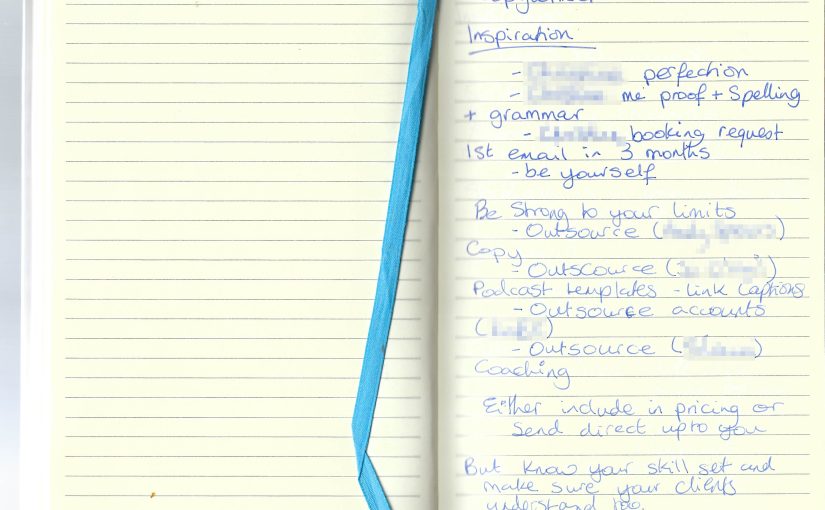
Helping ideas leave notebooks and conversations.
Helping expertise become something useful to somebody else.
So if you ask me what I do, you’ll probably never hear me describe myself as a copywriter.
You’ll hear me describe myself as a dyslexic enabler.
And honestly, that feels much closer to the truth.
Ready to make your business work your way?
If this article has sparked an idea, highlighted a challenge, or simply made you stop and think, let’s have a chat. I offer a free, no-obligation discovery call where we can explore what’s working well, what’s getting in your way, and whether I can help you save time and create systems that fit the way you work.
👉 Book your free discovery call here: https://tidycal.com/3zd5zj1/blog-discovery-call-clone20250506083047