Sometimes the most useful things in business — especially when it comes to capacity planning for small business — aren’t complicated systems or fancy tools.
Sometimes… it’s a wall.
And a pen.
I wasn’t trying to create anything clever.
I just needed to see — properly see — what my next few months actually looked like, and without realising it, I’d started my own version of capacity planning for small business.
So I mapped it out.
Not tasks.
Not to-do lists.
Just hours.
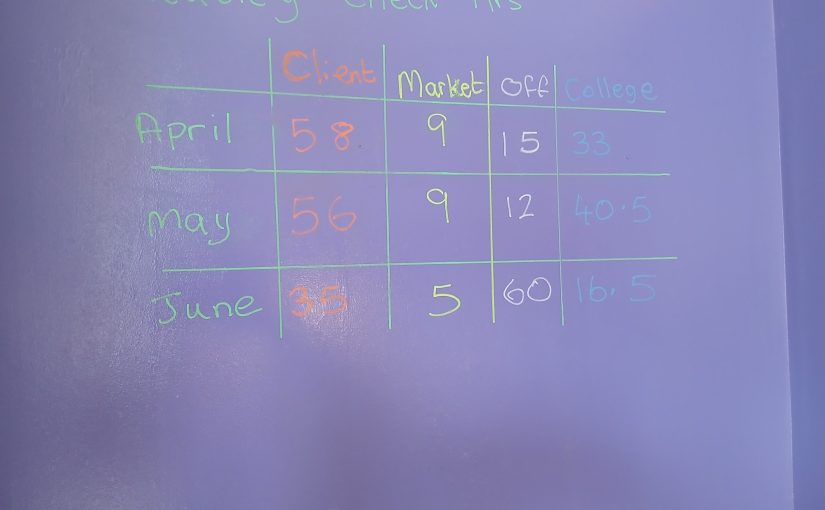
Here’s what that looked like on my wall:
What I Actually Tracked (Without Overthinking Capacity Planning for Small Business)
split my time into four simple categories:
- Client
- Marketing
- Off (time away / not working)
- College
And I mapped out April, May, and June.
That’s it.
No spreadsheets.
No formulas.
Just a visual “this is my life” overview.
And Then Something Clicked About Capacity Planning for Small Business
When I stepped back and looked at it…
I realised something really important:
👉 My capacity isn’t consistent month to month.
And I don’t mean “it feels busy.”
I mean physically, mathematically different.
- April: strong client capacity
- May: slightly less
- June: significantly reduced (because I’m away for two weeks)
Nothing dramatic.
Nothing wrong.
Just… reality.
Why Capacity Planning for Small Business Matters More Than You Think
This is where most small business owners get caught out.
You’re looking at your business thinking:
- “Why does this month feel harder?”
- “Why can’t I fit everything in?”
- “Why am I behind?”
But you’re comparing:
👉 A high-capacity month
with
👉 A low-capacity month
…as if they’re the same.
They’re not.
And your wall (or lack of one) is quietly proving it.
Many small business owners struggle with this because they don’t have clear visibility of their time (see guidance on starting a business here: https://www.gov.uk/set-up-business
The Bit That Changes Everything
1. You set better expectations
You stop over promising in months where you physically have less time.
2. You avoid overbooking
Because you can literally see there isn’t space.
3. You drop the guilt
“Not this month” stops feeling like failure…
and starts feeling like good decision-making.
A Small (But Powerful) Next Step
If you wanted to take this one step further, you could loosely notice what sits inside “client” time:
- 💼 Client delivery
- 🧾 Admin
- 🏡 Life admin
Not to over-track.
Just to spot patterns.
Because sometimes it’s not the work that’s heavy…
…it’s everything wrapped around it.
The Real Takeaway
This wasn’t meant to be a system.
It was just me trying to get my head straight.
But it’s turned into something really useful:
👉 A simple, visual capacity reality check
And honestly?
Most overwhelm I see in small business owners isn’t about workload.
It’s about invisible capacity limits.
If this is resonating, you might also find this helpful: Communication in Small Business: Are You Saying One Thing and Doing Another?
Quick Reality Check for You
If you paused right now…
Could you answer:
- How many hours you actually have this month?
- How much of that is already committed?
- What’s realistically left?
If not — that might be your starting point
Final Thought
You don’t need a complicated planner.
You don’t need another system.
Sometimes you just need to make your time visible.
Because once you can see it…
👉 You can work with it, not against it.